2D tank sloshing — forced roll, and the ballast tank as a passive roll damper
Partially-filled rectangular tank under prescribed roll, verified against analytical sloshing theory and a recognised forced-roll benchmark, then swept over fill and frequency and reduced to the added roll damping a ballast tank contributes as a passive tuned-liquid-damper.
VERIFIED · real OpenFOAM v2312
The problem
A partially-filled tank contains a gravity-driven free-surface (sloshing) mode. Tune its first-mode period near a vessel's roll natural period and the sloshing moment acts out of phase with roll — a passive tuned-liquid-damper, the naval "anti-roll tank." This page verifies the 2D CFD machinery for that problem: prescribed tank roll on a rigid moving mesh, partial fill via VOF, extraction of the tank reaction moment, and reduction to frequency-dependent added roll inertia and damping.
Method
Rigid whole-mesh roll motion θ(t) = θ₀·sin(ωt) via the ESI solidBody motion
solver (dynamicMotionSolverFvMesh + motionSolver solidBody) — a pure rigid
transform, robust on 2D slabs. Partial fill is initialised with setFields snapped so the
still-water surface lands on a cell face. The first-mode sloshing natural frequency of a rectangular tank
of breadth L and fill depth h is the analytical target:
which saturates in deep fill (set by L) and collapses toward the shallow-water speed
√(gh) in shallow fill — so fill depth is the dominant tuning knob.
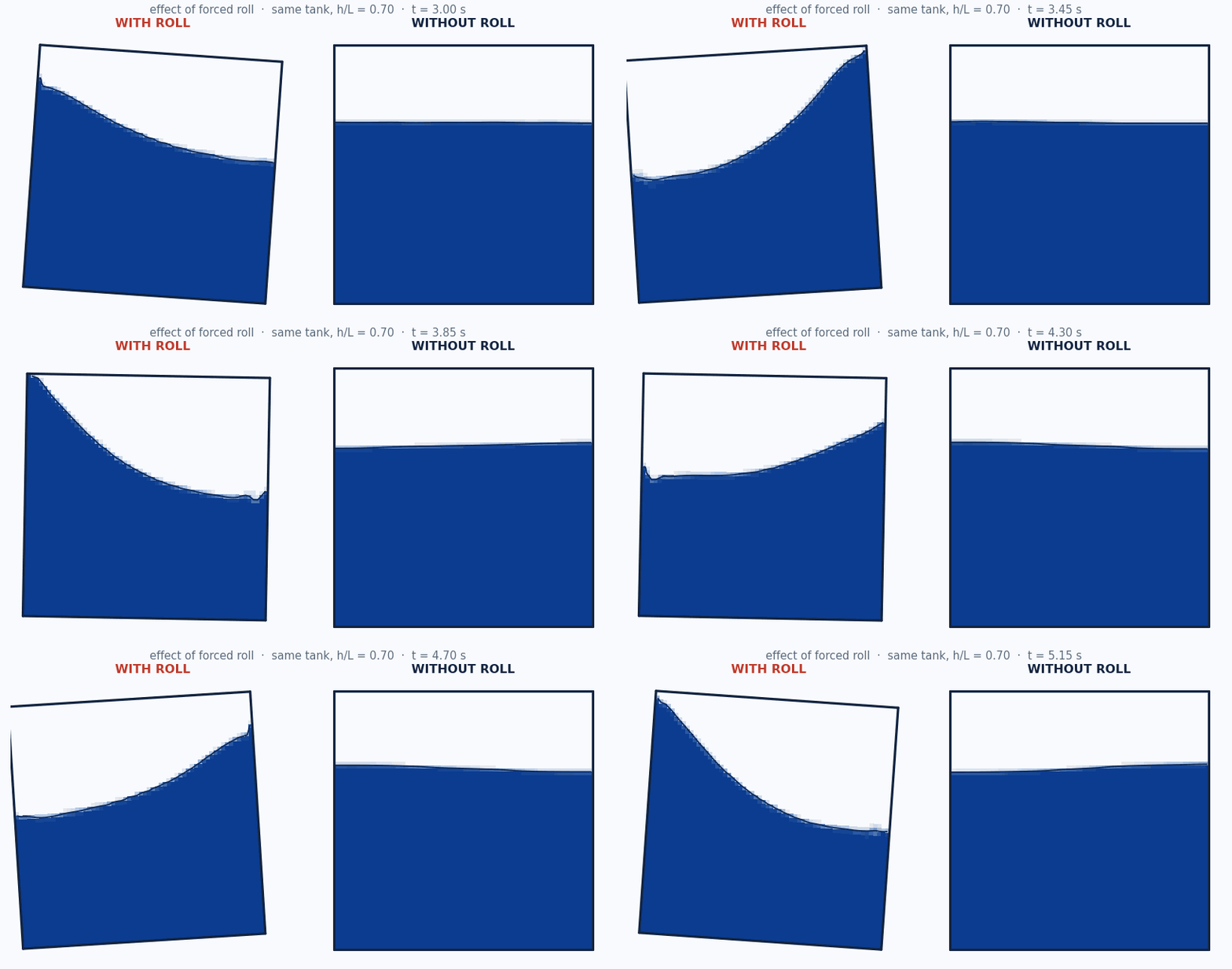
Free-surface visualization — the effect of roll
Real 2D VOF free-surface fields from OpenFOAM v2312. Left: with forced roll, the tank sloshes wall-to-wall; right: without roll, the surface stays flat and calm — the mechanism this study quantifies. Shown at h/L = 0.70 (water navy, air pale, interface at α = 0.5).
Verification 1 — natural frequency, across the fill range
Free-decay: the tank is given a small free-surface perturbation and rings down; the fundamental
frequency is extracted by FFT and compared to the analytical tanh dispersion. Bracketed at
intermediate and deep fill:
| Regime | Tank (L, h) | Measured | Analytical | Error |
|---|---|---|---|---|
| Intermediate (h/L = 0.3) | 1.0 m, 0.3 m | 0.75587 Hz | 0.75805 Hz | 0.29% |
| Deep / standing-wave (h/L = 0.7) | 1.0 m, 0.7 m | 0.87258 Hz | 0.87260 Hz | 0.002% |
Verification 2 — forced roll vs the SPHERIC benchmark
The recognised 2D forced-roll rectangular-tank benchmark (Delorme et al. / SPHERIC): L = 0.9 m, h = 0.093 m (~18% fill), 4° roll at the benchmark drive period (T ≈ 1.63 s). The case runs stably to t = 8.1 s on the 2D moving mesh and reproduces the characteristic violent shallow-water sloshing:
| Quantity | Value | Note |
|---|---|---|
| Wall run-up above still level | 0.064 m | ~69% of still depth |
| Stability | t = 8.1 s | stable, no mesh blow-up |
| Dominant surface response | ≈ 1.21 Hz | ≈ 2× drive (impact-per-cycle harmonic) |
Quantitative pressure matching has since been completed against the published SPHERIC experimental statistics: the CFD first-impact peak at Sensor 1 is 4,688 Pa vs the experimental 3,710 ± 732 Pa (100-run mean ± σ, CoV ≈ 20%) — inside the 2σ scatter band (2,246–5,174 Pa), consistent with the known VOF tendency to over-predict impact peaks. Full traces and discussion: the 2D CFD study →
Application — ballast tank as a passive roll damper
For each {fill × drive frequency} the tank roll-reaction moment M(t) is extracted from a
forces function object about the roll axis and reduced against the imposed roll into an
in-phase (stiffness/inertia-like) and a quadrature (damping) coefficient. A 3×3 sweep — fill
{25, 50, 70}% × three drive frequencies — run through a reduced-order coupling model answers the design
question directly: which fill best damps roll near a target period?
| Drive freq | Period | Best anti-roll fill | Peak quad. coeff. |
|---|---|---|---|
| 0.682 Hz | 1.47 s | 25% | — |
| 0.784 Hz | 1.27 s | 70% | 2.02 N·m/(rad/s) |
| 0.923 Hz | 1.08 s | 70% | — |
What this gates & how to run
This verifies the path from prescribed tank motion → partial-fill VOF → tank moment → reduced-order
roll coupling. It gates coupled tank-sloshing / roll studies (anti-roll ballast tanks, sloshing loads at
partial fill). The engine lives in digitalmodel:
References
- O. M. Faltinsen & A. N. Timokha (2009), Sloshing, Cambridge University Press — analytical natural frequency, multimodal & damping theory, anti-roll tanks.
- L. Delorme, A. Colagrossi, A. Souto-Iglesias et al. (2009), "A set of canonical problems in sloshing, Part I: pressure field in forced roll," Ocean Engineering 36(2) — the forced-roll benchmark (SPHERIC test case).
- ITTC 7.5-02-07-04.5, Numerical Estimation of Roll Damping — treats anti-roll tanks as a roll-damping contributor.
- H. N. Abramson (ed.) (1966), The Dynamic Behavior of Liquids in Moving Containers (NASA SP-106) — equivalent-mechanical models and baffle damping.